Do Laser Printers Last Longer Than Inkjet?
Yes, laser printers usually last longer than inkjet models. A laser has no wet ink to dry out or clog, so the parts that wear out are the toner cartridge and the drum, and both are replaced while the printer keeps working.
On this page (9 sections)
- Do laser printers last longer than inkjet? The short answer
- Why do laser printers usually outlast inkjet models?
- How long does toner last in a laser printer before it needs replacing?
- What usually kills a laser printer, and can you prevent it?
- How is an inkjet different in everyday ownership?
- Does print volume change the answer?
- Which laser printers hold up for home use?
- The one habit that matters most
- So, do laser printers really last longer than inkjet?
Yes, laser printers usually last longer than inkjet models. A laser has no wet ink to dry out or clog, so the parts that wear out are the toner cartridge and the drum, and both are replaced while the printer keeps working.
That answers the headline question, but the details decide whether a specific printer gives you 3 years or 10. If you want a home machine that sits idle for weeks and still prints on demand, the laser has the clear edge.
Do laser printers last longer than inkjet? The short answer
For most home and office use, a laser printer outlasts an inkjet. The reason is simple: laser printing is a dry process, while inkjet printing depends on liquid ink staying liquid.
An inkjet's weakest point is the printhead. Ink dries in the nozzles during idle weeks, and repeated cleaning cycles waste ink and stress the head.
A laser has no nozzles at all.
Laser printers also use paper handling built for higher monthly volumes. Trays and feed paths on a monochrome laser are sized for business documents, which is why many office lasers stay in service for a decade.
That doesn't mean lasers are indestructible. Dust, humidity, cheap paper and jammed sheets wear any printer out.
The point is that the inkjet's most common failure mode simply doesn't exist on a laser.
Why do laser printers usually outlast inkjet models?
The dry toner system is the main reason. Toner is a powder that sits in a sealed cartridge until heat and pressure fuse it to paper.
There's nothing in the cartridge to evaporate or clog.
Inkjet ink, by contrast, is a liquid with water or solvent in it. A printer that sits unused lets that liquid thicken, and the printhead can dry solid.
Owners who print a few pages a month are the classic case.
Lasers also skip the frequent cleaning cycles that inkjets run to stay healthy. Those cycles cost ink and time, and a printer that runs them often does more mechanical work per page.
Finally, the wear parts on a laser are designed to be swapped. A toner cartridge and a drum unit are consumables, not repairs.
The chassis keeps running through several of them.
Compact models like the Brother HL-L2460DW reach a first page in about 8.5 seconds. Less waiting per job means fewer long, hot cycles on the fuser, and that adds up over years of steady use.
How long does toner last in a laser printer before it needs replacing?
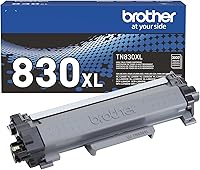
Toner life is measured in pages, not months. The Brother Genuine TN830 is rated at up to 1,200 pages, and the printer manages the rest of the system around it.
For a deeper look at page yields and drum life, read how long does toner last in a laser printer.
The drum is the other part with a finite life. On many Brother models the drum unit is a separate piece, so you replace it less often than the toner.
That's a real advantage for long-term ownership.
The Brother toner line shows the range clearly. The TN830 standard cartridge, the TN830XL high yield and the TN830XL 2PK twin pack all fit the same machines.
You pick the yield that matches your page count, so a light user isn't forced to buy a giant cartridge and a busy office isn't refilling every few weeks.
Tracking pages per month tells you more about cost than the calendar. Small households may replace toner once a year, while busy home offices go through several cartridges.
What happens when the toner runs low?
When a Brother laser reports low toner, Toner Save Mode can stretch the remaining toner until your replacement arrives. Unlike an inkjet, there's no risk of a dried-out head ruining the next job.
You order the replacement, fit it in a minute, and the printer is back to full quality. That no-drama refill is a big part of why a laser stays in service longer.
What usually kills a laser printer, and can you prevent it?
The printer body rarely dies from age alone. Paper feed rollers, the fuser and dust buildup are the common wear points, and each has a cheap prevention.
Feed rollers pick up paper dust and lose grip. Wiping them with a lint-free cloth helps sheets feed straight.
Dry, good-quality paper prevents most jams and reduces wear on every roller.
Dust around the fuser and vents traps heat. A quick vacuum with a soft brush keeps airflow clear.
Keep the printer out of steamy bathrooms and damp basements, because moisture clumps toner and warps paper.
The fuser eventually wears out, especially on high-volume machines. That's the one repair that can cost real money.
On a cheap home laser, a fuser failure is often the point where replacing the printer makes sense.
How is an inkjet different in everyday ownership?
An inkjet's main enemy is idle time. Ink dries in the printhead, and the printer compensates with cleaning cycles that use ink and add wear.
The result is a machine that can fail while barely printing anything.
Buyers who print photos weekly often do fine, because the ink keeps moving. Buyers who print a shipping label once a month are the ones who find a clogged head.
Many cartridges also stop working long before they're empty.
Inkjets also have more moving parts near the paper path. Sheet feeders and photo trays add complexity.
More parts means more chances for something to stick or wear.
None of this makes inkjets bad. They win on color photo quality and low entry cost.
It's long-run reliability and idle tolerance where the laser is ahead.
Does print volume change the answer?
Yes, and it's the single biggest factor. A lightly used laser and a lightly used inkjet are both long-lived in years, but only the laser survives the gaps between jobs.
High-volume users see the opposite pressure. A busy office laser wears through rollers and fusers faster, though its duty cycle is built higher.
Inkjet models at the same volume run constant cleaning cycles and drain cartridges.
So match the printer to your monthly pages. If you print under 100 pages a month, a laser's idle tolerance is the whole ballgame.
Above a few hundred pages, both types work hard, and laser cost per page stays lower.
Both Brother models here print at up to 36 pages per minute with automatic duplex. A busy home office clears a long document in minutes and lets the printer rest, while a slow inkjet runs longer and hotter for the same stack of paper.
Faster output per job means less mechanical wear per page.
Which laser printers hold up for home use?
A compact monochrome laser is the simplest long-life choice, because it has fewer features to wear out and a toner-based consumable plan. Here are three that fit that pattern.
The Brother HL-L2460DW is the print-only pick: up to 36 pages per minute, automatic duplex, a 250-sheet tray and dual-band wireless. Fewer functions mean fewer things to fix.
Owners looking at options from another brand can read our hp laser printer roundup before deciding.
The Brother DCP-L2640DW adds copy and scan with a 50-page document feeder. It costs more and has more parts, but it replaces two other machines.
If you're weighing the brand broadly, see are brother laser printers good.
Both run on Brother Genuine TN830 or TN830XL toner, and the drum unit is a separate replacement. That keeps the chassis in service across multiple consumable changes.
For the wider comparison, read are laser printers better than inkjet.
How do the two Brother models differ for long-term ownership?
The HL-L2460DW is smaller at 14.2 by 14 by 7.2 inches and lighter at 15.6 pounds. It prints only, so the moving parts are limited to the paper feed and the print engine.
A single-purpose machine has less to break.
The DCP-L2640DW measures 15.7 by 16.1 by 12.5 inches and weighs 25 pounds. It adds a scanner and copier plus the 50-page document feeder, and its copy resolution is 600 by 600 dpi.
The extra functions mean more to maintain, but they replace a separate scanner and a separate copier. One well-built multi-function laser can outlast three cheap devices that each fail on their own schedule.
The one habit that matters most
Use the printer regularly and keep it dry. A laser that prints a few pages a week stays loose and clean, and one that sits for months gathers dust and humidity.
That habit adds years to any model.
Dry paper is the other easy win. Damp sheets jam, crumple and stress the feed path.
Store paper sealed, and load only what you'll use in a month.
Wipe the exterior and vents now and then. Replace toner when prompted, and the drum when it wears.
The printer rarely needs anything else.
So, do laser printers really last longer than inkjet?
In most homes, yes: do laser printers last longer than inkjet is a question with a clear answer, and the laser wins on idle tolerance and swappable wear parts. Toner doesn't dry, and the drum and cartridge are designed to be replaced.
Pick a laser if you print in bursts, mostly in black and white, and want the machine to stay ready. Choose an inkjet if color photos matter more than years of service.
Either way, a dry spot and steady paper do most of the work.
For most readers replacing a dying inkjet, the print-only Brother HL-L2460DW is the simplest long-life starting point. Add the DCP-L2640DW if you scan and copy often.
Frequently asked questions
Does a laser printer last longer if I print every day?
Not necessarily. Daily use is gentler on a laser than on an inkjet, because there's no ink to dry at the nozzles.
A laser still ages through paper wear, dust and duty cycle, so steady light use and regular cleaning do more for it than marathon jobs.
Can an inkjet last as long as a laser?
It can, if it's a well-built model used often enough to keep its ink flowing and cleaned on schedule. Most inkjet failures come from idle time and clogged heads, not from the print mechanism wearing out.
The gap closes with constant use and widens with occasional use.
What usually fails on a laser printer first?
The toner cartridge runs out first, and the drum unit wears next on models where it's separate. Paper feed rollers, fuser life and dust buildup are the other common wear points.
That order helps you plan costs, because the first two are normal running supplies, not repairs.
Do laser printers need much maintenance?
Less than inkjets. Wipe dust from the paper tray and vents, use dry paper, and replace toner and drum when the printer asks.
There are no printheads to clean or nozzles to unclog.
Keep it out of humid rooms and avoid cheap, damp paper that feeds poorly.